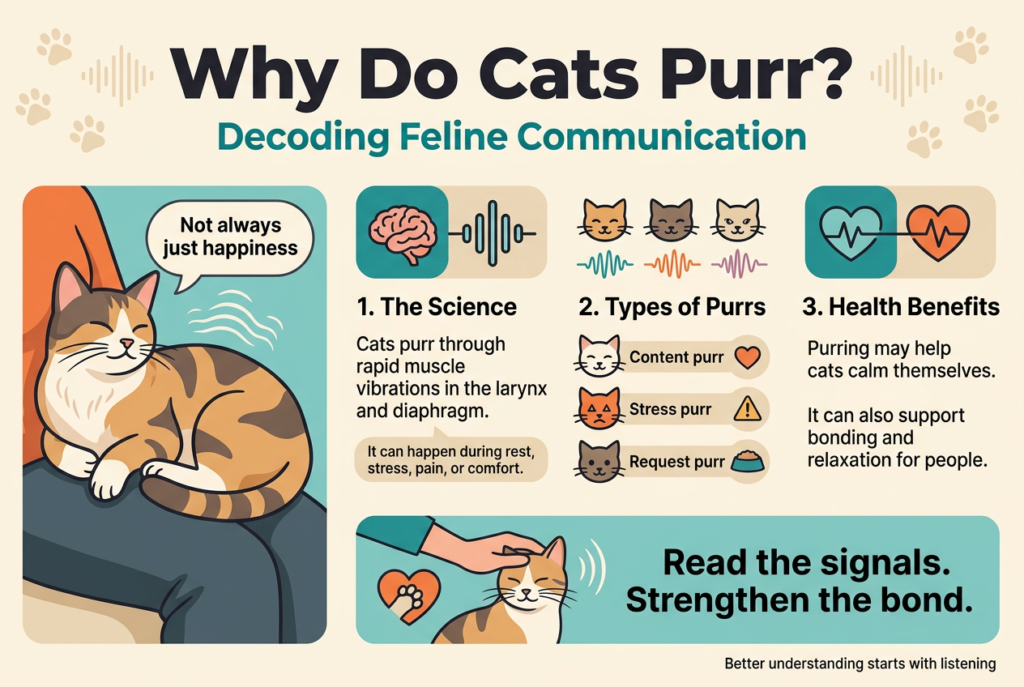
This guide is for cat owners and curious animal lovers who want to go beyond the basics and actually understand what their cat is trying to tell them. We’ll break down the science behind why cats purr, walk through the different types of purrs and what each one means, and share some genuinely surprising health benefits that come with having a purring cat in your life.
By the end, you’ll have a much better read on your cat’s communication style — and a few practical ways to use that knowledge to build a stronger bond with them.
The Science Behind Cat Purring
How Cats Physically Produce the Purring Sound
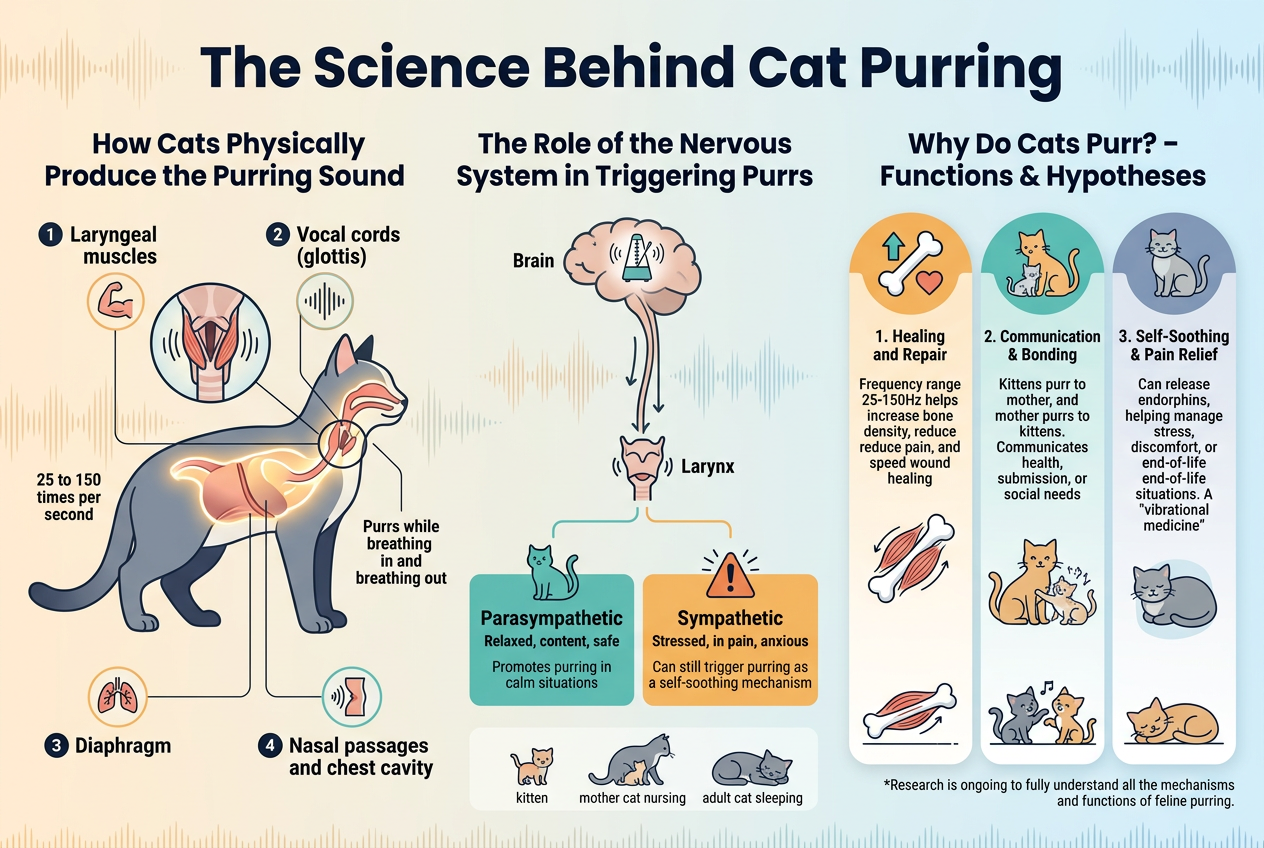
Cats are the only animals on earth that can purr both while breathing in and breathing out — and that’s actually a pretty big deal. The secret sits in the larynx, or voice box. Cats have a unique set of muscles surrounding their vocal cords that rapidly dilate and constrict the glottis (the part of the larynx that surrounds the vocal cords) with every breath cycle. This rapid movement — happening roughly 25 to 150 times per second — causes a sudden separation of the vocal cords during both inhalation and exhalation, which produces that signature rhythmic rumble we know and love.
What makes this even more fascinating is that there’s no dedicated “purring organ.” The entire mechanism is built from structures cats already use for breathing and vocalizing. The diaphragm acts as the engine, pushing air across those rapidly twitching laryngeal muscles. The result is a continuous, rolling vibration rather than a staccato burst of sound.
Here’s a quick breakdown of the physical components involved:
-
Laryngeal muscles — rapidly contract and relax to interrupt airflow
-
Vocal cords (glottis) — separate during each breath to generate vibration
-
Diaphragm — drives the airflow that makes the whole system work
-
Nasal passages and chest cavity — act as resonating chambers, amplifying the sound
This is why you can often feel a cat purring as much as you can hear it. The vibrations travel through their entire body, which is part of what makes sitting with a purring cat feel so physically calming.
The Role of the Nervous System in Triggering Purrs
Purring isn’t a reflex — it’s a controlled behavior driven by the central nervous system. Specifically, a repetitive neural oscillator in the cat’s brain sends rhythmic signals down to the laryngeal muscles, essentially telling them to twitch on and off at a very consistent rate. Think of it like a metronome buried deep in the brainstem, keeping everything in sync.
What’s interesting is that cats can voluntarily control whether they purr. They’re not like hiccups, which happen without your permission. A cat chooses, consciously or semi-consciously, to engage that neural pattern. That said, the triggers for activating it are largely emotional and situational rather than deliberate thought.
The two main branches of the autonomic nervous system play a role here:
| Nervous System Branch | Associated State | Effect on Purring |
|---|---|---|
| Parasympathetic | Relaxed, content, safe | Promotes purring in calm situations |
| Sympathetic | Stressed, in pain, anxious | Can still trigger purring as a self-soothing mechanism |
The fact that both branches can lead to purring explains why cats purr when they’re happy and when they’re injured or frightened. The nervous system isn’t just expressing emotion — in stressful situations, it may be using purring as a built-in coping tool, almost like how some people hum or tap their fingers when they’re nervous.
Kittens develop the neural capacity to purr within days of birth, and mother cats purr while nursing. Scientists believe the neural patterning for purring is hardwired from a very early age, reinforced through early social bonding experiences.
Why Purring Frequencies Range Between 25 and 150 Hz
The frequency range of a cat’s purr — 25 to 150 Hz — isn’t random. It turns out this specific range overlaps almost perfectly with the frequencies that research has shown to promote bone density, accelerate healing in soft tissue, and reduce pain. That’s not a coincidence most scientists are willing to wave away.
Different cats purr at slightly different frequencies depending on their size, age, and even emotional state:
-
Domestic cats typically purr between 25–50 Hz, with some reaching up to 150 Hz during solicitation purring (more on that in a later section)
-
Larger wild cats like cheetahs and cougars that can purr tend to fall within similar ranges
-
Kittens often purr at slightly higher frequencies than adult cats
The 25 Hz baseline is particularly significant. Vibrations at this frequency have been shown in clinical research to stimulate bone growth and repair. Cats have a remarkable ability to recover from injuries that would be far more debilitating in other similarly-sized animals — like falls from considerable heights — and some researchers point to their constant low-frequency self-vibration as a likely contributing factor.
Here’s a comparison of what different frequency ranges are associated with biologically:
| Frequency Range | Known Biological Effects |
|---|---|
| 25–50 Hz | Bone density promotion, fracture healing |
| 50–100 Hz | Tendon and muscle repair, pain reduction |
| 100–150 Hz | Edema reduction, respiratory support |
Cats essentially carry a natural vibration therapy device inside their own bodies. Whether this evolved because of its healing properties or whether the healing effects are a happy side effect of a communication tool, researchers are still working out. Either way, the fact that a cat’s purr lands precisely in this therapeutic window makes it one of the more remarkable biological coincidences — or adaptations — in the animal kingdom.
Key Reasons Why Cats Purr
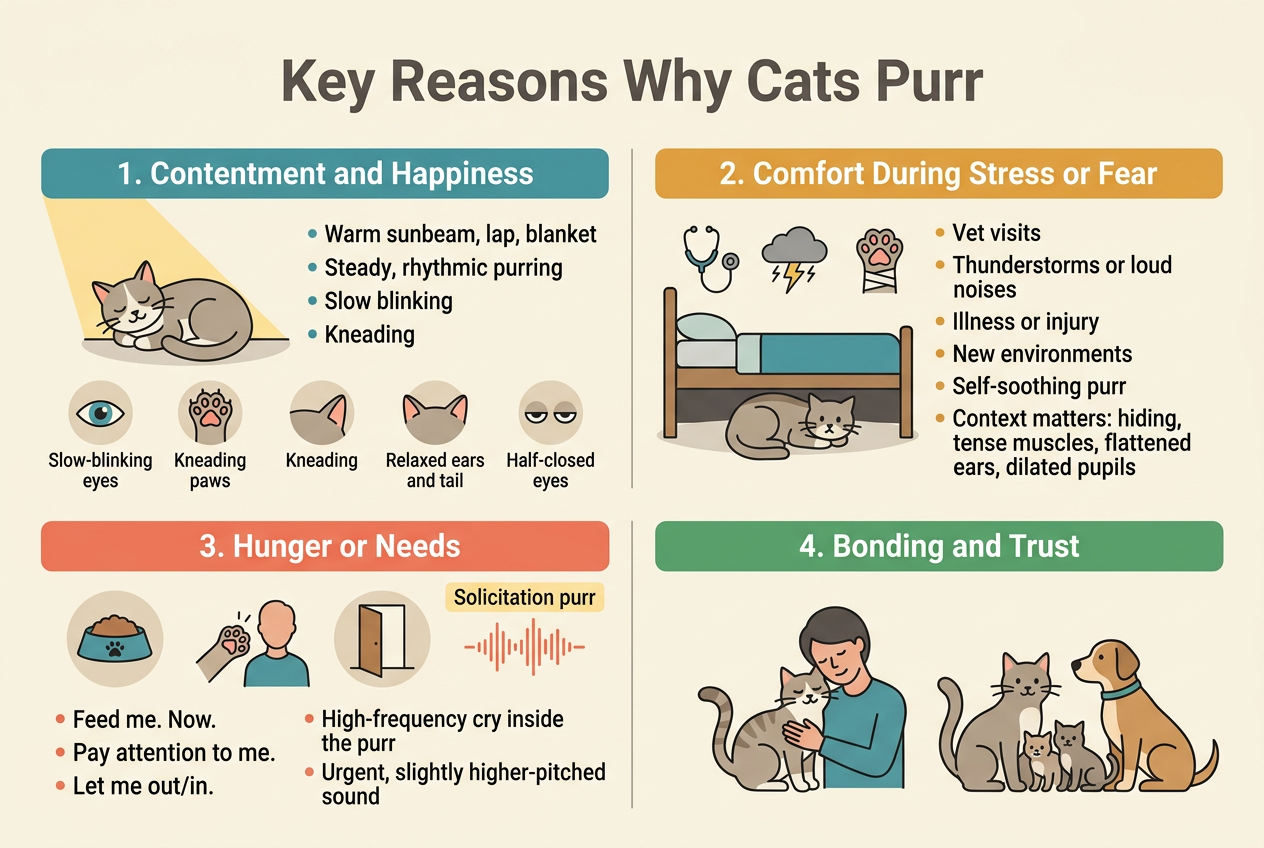
The most familiar reason cats purr is simply because they feel good. When your cat is curled up in a warm sunbeam, kneading a blanket, or sprawled across your lap while you stroke their fur, that rumbling sound is basically their version of a happy sigh. It’s their way of saying, “Life is pretty great right now.”
What’s interesting is that this kind of purring tends to have a steady, rhythmic quality. It’s consistent and low-key, almost like a background hum. Cats often pair it with other relaxed body language:
-
Slow blinking – sometimes called “cat kisses,” this signals deep trust and comfort
-
Kneading – a throwback behavior from kittenhood associated with nursing and safety
-
Relaxed ears and tail – no tension, no alertness, just pure chill
-
Half-closed eyes – the feline equivalent of lounging on a hammock
It’s easy to take this type of purring for granted, but it’s actually one of the clearest windows into your cat’s emotional world. When they purr in your presence, they’re not just comfortable — they genuinely feel safe with you around. That’s a big deal coming from an animal that’s both predator and prey by nature.
Seeking Comfort During Stress or Fear
Here’s something that surprises a lot of cat owners: cats don’t only purr when they’re happy. They also purr when they’re scared, in pain, or feeling stressed out. It sounds counterintuitive, but think of it like how some people hum to themselves when they’re nervous — it’s a self-soothing mechanism.
Cats are known to purr in situations like:
-
Vet visits – even when they’re clearly terrified
-
Thunderstorms or loud noises – when they’ve retreated to hide under the bed
-
Illness or injury – a cat in physical pain may purr continuously
-
New environments – moving to a new home, meeting new people, or encountering unfamiliar animals
Researchers believe that the vibrations produced during purring may actually trigger the release of calming neurochemicals in a cat’s brain. So when a cat purrs under stress, they’re essentially using their own built-in coping tool. It’s a way to regulate their emotional state and manage discomfort.
This is why you should always pay attention to context. A purring cat isn’t automatically a happy cat. If your cat is hiding, has tense muscles, flattened ears, or dilated pupils, the purr you’re hearing is a distress signal — not a sign of contentment. Learning to read the whole picture, not just the sound, makes a world of difference in understanding what your cat actually needs.
Communicating Hunger or Needs to Owners
Cats are smart, and over thousands of years of living alongside humans, they’ve figured out exactly how to get our attention. One clever strategy? A special kind of purr that’s almost impossible to ignore.
Researchers at the University of Sussex identified what they call the “solicitation purr” — a purr specifically used by cats when they want something, usually food. What makes it distinctive is a high-frequency cry embedded within the low rumble of a normal purr. This cry sits at a similar frequency to a human baby’s cry, which means it taps directly into our instinct to respond and take action.
Basically, your cat has figured out how to push your buttons. And it works incredibly well.
You’ll notice solicitation purring tends to show up in specific situations:
| Situation | What Your Cat Is Saying |
|---|---|
| Standing by the food bowl in the morning | “Feed me. Now. I’m serious.” |
| Pawing at you while purring | “Pay attention to me.” |
| Purring near the door | “Let me out/in.” |
| Purring loudly while staring at you | “You clearly have forgotten something important.” |
This type of purr is more urgent-sounding and slightly higher-pitched than a contentment purr. Once you tune into it, you’ll start recognizing the difference almost automatically. Many cat owners describe it as “more annoying” — which is kind of the whole point. Your cat is designed to get a response out of you, and they’re very good at it.
Bonding With Humans and Other Animals
Purring plays a huge role in how cats build and maintain close relationships — both with the humans they live with and sometimes with other animals in the home.
When a cat purrs while grooming you, sleeping pressed against you, or simply sitting nearby while you work, they’re communicating connection. It’s a form of social bonding that says, “You’re part of my inner circle.” Cats are often stereotyped as independent and aloof, but purring tells a very different story. It’s an active, ongoing form of communication that keeps the relationship warm.
Between cats and humans:
-
Cats often reserve their purring for humans they trust deeply
-
A cat that purrs when you return home after being away is expressing relief and attachment
-
Mutual purring sessions — where you talk softly and your cat purrs in response — are a genuine form of two-way communication
-
Cats who purr while being held or cuddled are reinforcing the safety they feel with that specific person
Between cats and other animals:
-
Mother cats purr to their kittens almost constantly during the early weeks of life, helping the kittens feel secure and guiding them while nursing
-
Kittens begin purring within days of birth, partly as a way to signal to their mother that they’re okay
-
Some cats will purr near other household pets — dogs, rabbits, even other cats — as a way of signaling non-threatening, friendly intentions
The bond formed through purring is genuine. Cats choose who they open up to, and if your cat purrs around you regularly, you’ve earned a place in their world. That’s not something they hand out freely.
Surprising Health Benefits of Cat Purring
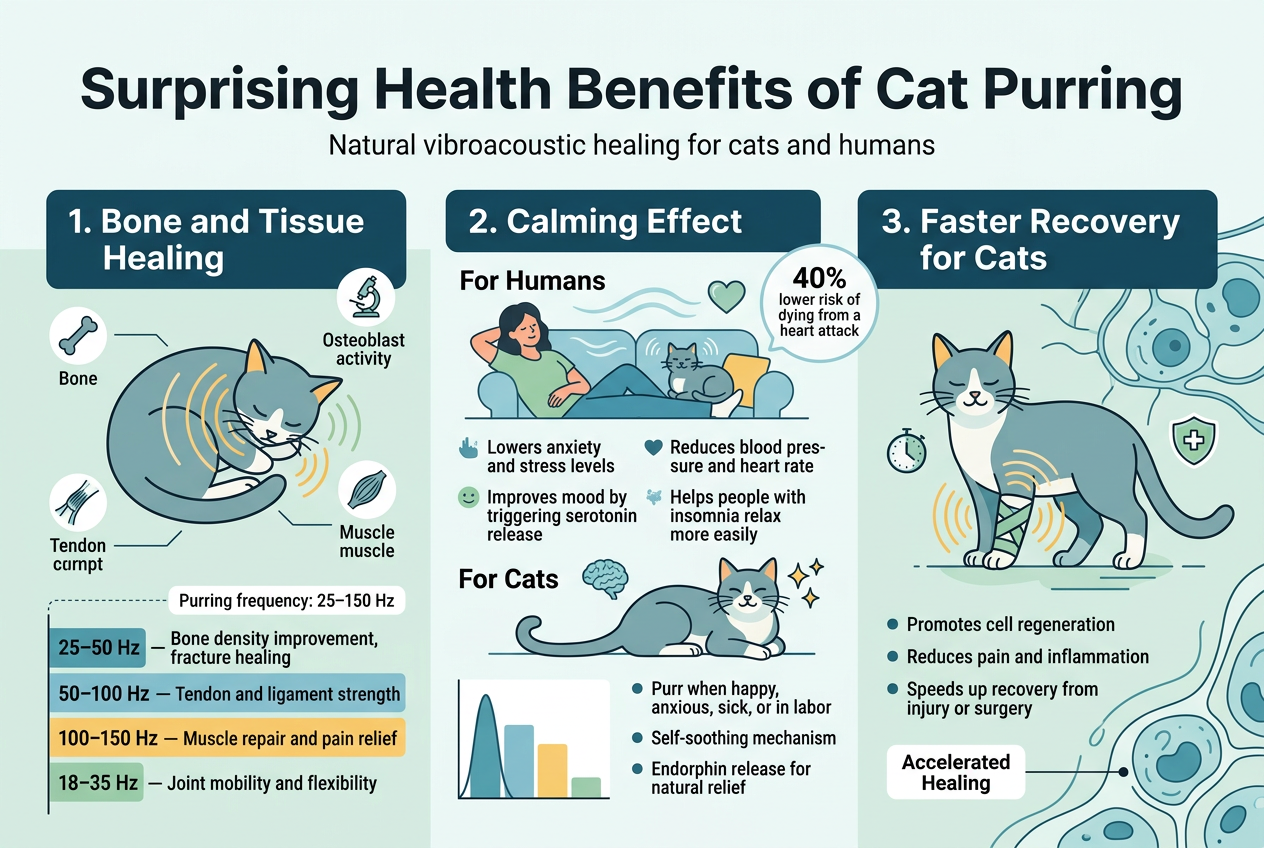
One of the most jaw-dropping discoveries about cats is that their purring isn’t just a cute quirk — it’s essentially a built-in healing machine. Cat purrs typically fall within a frequency range of 25 to 150 Hz, and this is where things get genuinely fascinating. Vibrations within this specific range have been scientifically shown to promote the growth and strengthening of bones, tendons, and muscles.
Here’s why that matters: orthopedic researchers have long known that low-frequency vibrations applied to bone tissue stimulate osteoblast activity — the cells responsible for building new bone. Cats, through the simple act of purring, expose their own bodies to this therapeutic vibration constantly. It’s almost like they naturally invented what physical therapists have been trying to replicate with machines.
The breakdown of frequency benefits looks something like this:
| Frequency Range | Biological Effect |
|---|---|
| 25–50 Hz | Bone density improvement, fracture healing |
| 50–100 Hz | Tendon and ligament strength |
| 100–150 Hz | Muscle repair and pain relief |
| 18–35 Hz | Joint mobility and flexibility |
This isn’t speculation — studies published in the Journal of the Acoustical Society of America and research cited by NASA have pointed toward vibroacoustic therapy as a legitimate path to tissue repair. Cats may have evolved this ability partly as a survival mechanism: quiet, energy-efficient self-healing during periods of rest.
The Calming Effect of Purring on Both Cats and Humans
You already know that sitting next to a purring cat feels good. But what’s actually happening in your body when that rhythmic rumble washes over you is pretty remarkable.
For Humans:
When you hear and feel a cat purring, your nervous system responds almost immediately. The sound triggers a release of oxytocin — the same bonding hormone released during a warm hug or a good laugh with a close friend. Your cortisol levels (the main stress hormone) drop, your heart rate slows, and your blood pressure follows.
Research from the University of Minnesota’s Stroke Institute tracked cat owners over a 10-year period and found that people who owned cats had a 40% lower risk of dying from a heart attack compared to those who didn’t. While this can’t be attributed entirely to purring alone, the calming auditory and tactile experience of a purring cat is considered a significant contributing factor.
For Cats:
Cats don’t only purr when they’re happy. They purr when they’re anxious, sick, or in labor. Purring appears to function as an internal self-soothing mechanism — a kind of neurological comfort blanket that cats activate when the world feels uncertain or painful. The vibrations stimulate the release of endorphins in their brains, giving them a natural, chemical sense of relief.
How Purring Helps Humans Specifically:
-
Lowers anxiety and stress levels
-
Reduces blood pressure and heart rate
-
Improves mood by triggering serotonin release
-
Helps people with insomnia relax more easily
-
Acts as white noise, reducing mental chatter before sleep
Living with a purring cat is, without exaggerating, a passive form of stress therapy that costs nothing and happens naturally on the couch.
How Purring Helps Cats Recover From Injury Faster
Cats have a reputation for landing on their feet, healing quickly, and bouncing back from injuries that would sideline other animals for much longer. Some of this comes down to biology, but purring plays a surprisingly large role in that resilience.
Self-Generated Vibroacoustic Therapy
When a cat is injured or recovering from surgery, it purrs — often almost constantly. This isn’t just emotional comfort-seeking. Those purring vibrations act like a natural physiotherapy session running in the background. The 25–50 Hz frequencies directly stimulate bone cell regeneration, while the higher end of the spectrum targets soft tissue recovery.
Think about how human athletes use vibration platforms or ultrasound therapy to speed up recovery from muscle tears and stress fractures. Cats get a similar effect for free, from within their own bodies, every time they rest and purr.
Reduced Swelling and Pain Management
Purring vibrations also appear to reduce edema (swelling) in healing tissue. The gentle, rhythmic compression effect on surrounding cells promotes better circulation to the injury site, which means nutrients and oxygen reach damaged tissue faster. At the same time, the endorphin release triggered by purring helps cats manage pain without the need for anything external.
Energy Conservation During Healing
Healing is expensive in biological terms — it burns a lot of calories. Cats, as predators who evolved to conserve energy between hunts, seem to have developed purring partly as a low-energy way to keep their bodies in repair-ready condition. Lying still and purring requires almost no caloric expenditure while delivering real physiological benefits.
A quick look at how purring aids feline recovery:
-
✅ Stimulates bone cell growth without physical movement
-
✅ Promotes soft tissue repair during rest
-
✅ Reduces pain through endorphin release
-
✅ Improves circulation to injured areas
-
✅ Minimizes inflammation and swelling
-
✅ Supports respiratory function during chest injuries
Veterinarians have noticed that cats with access to calm, low-stress environments where they feel safe enough to purr frequently tend to recover more quickly than those in high-stress settings. Keeping a recovering cat comfortable and emotionally secure isn’t just kindness — it’s actively supporting the healing process at a biological level.
Different Types of Purrs and What They Mean
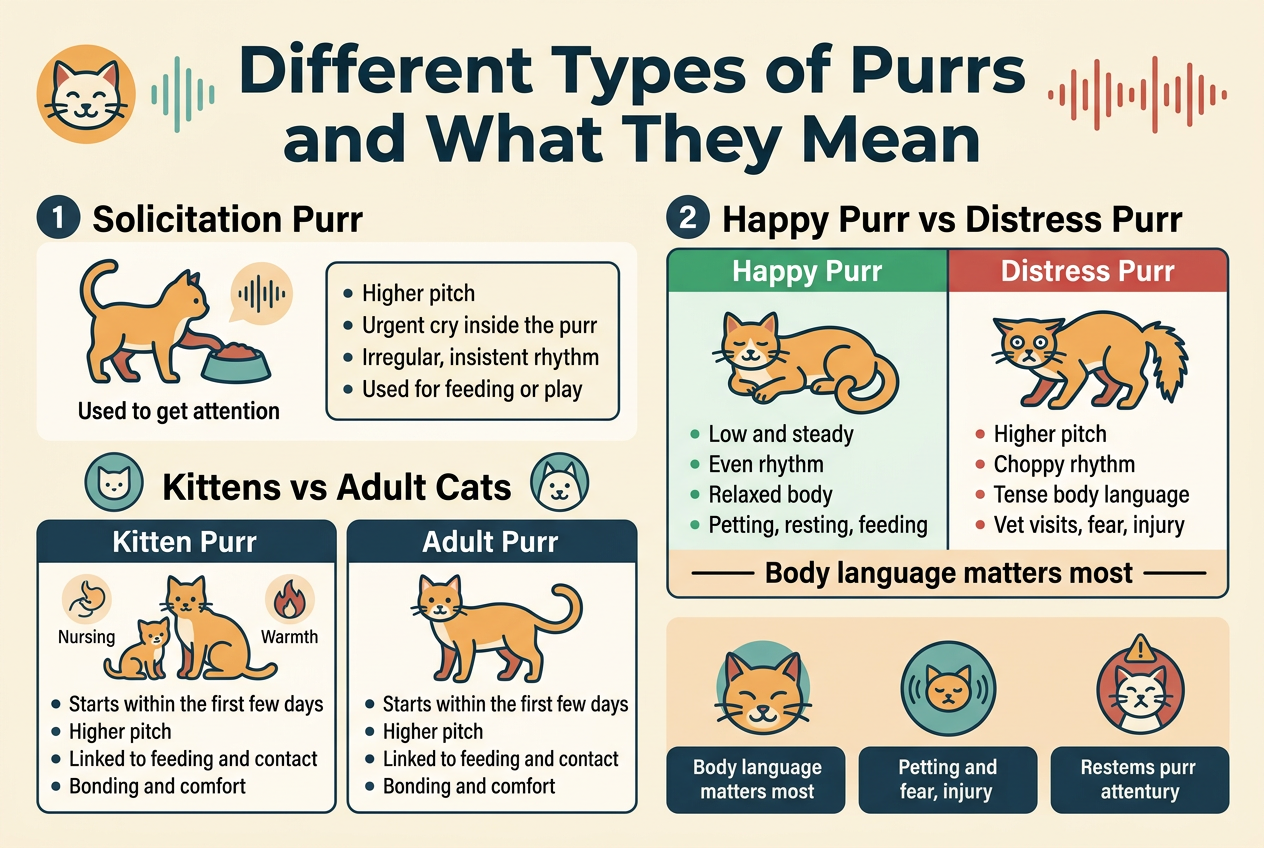
If you’ve ever been sound asleep at 5 a.m. only to be awakened by your cat’s insistent purring right next to your ear, you’ve already met the solicitation purr. Researchers at the University of Sussex, led by Dr. Karen McComb, identified this specific type of purr back in 2009, and it’s genuinely fascinating.
The solicitation purr is a clever acoustic trick. Your cat embeds a high-frequency cry — very similar in pitch to a human infant’s cry — right inside their regular purring sound. The result is a vocalization that humans find almost impossible to ignore. It triggers a built-in caregiving response in us, which is exactly what your cat is counting on.
Key characteristics of the solicitation purr:
-
Higher pitched than a regular contentment purr
-
Contains an embedded, urgent-sounding cry
-
Tends to be more insistent and rhythmically irregular
-
Usually paired with direct eye contact or physical nudging
-
Most commonly used around feeding time or when seeking play
Cats who live closely with their owners tend to develop stronger, more refined solicitation purrs over time. They essentially learn what works on you specifically. Some cats refine this vocalization to the point where it becomes almost irresistible, while others rely on it only occasionally. Either way, your cat has essentially reverse-engineered your psychology, and honestly, you have to respect that.
How to Distinguish a Happy Purr From a Distress Purr
Not all purring signals joy, and learning to tell the difference is one of the most useful skills a cat owner can develop. At first glance — or first listen — the two can sound remarkably similar, but once you know what to look for, they’re quite distinct.
The Happy Purr:
A contentment purr is typically low, steady, and rhythmically even. Your cat is relaxed, their body is loose, and they’re probably kneading or slowly blinking. The vibration feels gentle under your hand if you’re petting them.
The Distress Purr:
A distress purr tends to be:
-
Higher in pitch
-
More erratic in rhythm
-
Accompanied by tense body language — tucked limbs, flattened ears, wide pupils
-
Sometimes mixed with whimpering or crying sounds
-
Shorter in duration before breaking off
| Feature | Happy Purr | Distress Purr |
|---|---|---|
| Pitch | Low, consistent | Higher, variable |
| Rhythm | Even, smooth | Irregular, choppy |
| Body language | Relaxed, open | Tense, withdrawn |
| Context | Petting, resting, feeding | Vet visits, injury, fear |
| Duration | Long, sustained | Short bursts |
Body language is your best companion when reading your cat’s purr. A purring cat with a puffed tail, dilated pupils, and flattened ears is not a happy cat, regardless of what the purr might seem to suggest. Always read the whole picture, not just the sound.
The Unique Purring Patterns of Kittens Versus Adult Cats
Kittens start purring almost immediately after birth — usually within the first few days of life. This early purring serves a very specific survival purpose. When a mother cat is nursing, she can’t meow (since she’d have to interrupt her breathing), so kittens purr to communicate with her. It’s their way of saying, “I’m here, I’m okay, keep feeding me.”
Kitten purring traits:
-
Higher in pitch due to smaller body size and vocal anatomy
-
More rapid in vibration frequency
-
Closely tied to feeding and contact with the mother
-
Often activated by warmth or gentle touching
-
Used as a bonding signal and comfort mechanism
As cats grow into adults, their purring deepens and broadens in range. Adult cats develop more nuanced uses for the purr, expanding it beyond just mother-offspring communication into a full social tool used with humans and sometimes other cats.
Adult purring traits:
-
Lower, richer in tone
-
More varied in context — contentment, solicitation, self-soothing, communication
-
Can be consciously controlled and modulated based on social goals
-
Often louder and easier to detect at a distance
One particularly interesting thing about adult cats: they rarely meow at other cats. Meowing is largely a communication style reserved for humans, while purring tends to be more broadly social. Kittens, by comparison, meow frequently at their mothers. So in a way, your adult cat purring at you is actually a deeply ingrained form of intimacy — a kitten-like signal they’ve carried forward specifically because it works with you.
What It Means When a Cat Purrs While Being Petted
When your cat curls up in your lap and purrs steadily as you stroke their fur, that’s one of the clearest signals of feline contentment you’re going to get. This type of purring is strongly linked to the release of oxytocin — the same bonding hormone released in humans during positive social interaction. Your cat isn’t just tolerating you; they’re actively enjoying the connection.
That said, there are some nuances worth understanding about petting-induced purring.
What the purr during petting usually tells you:
-
Your cat feels safe and trusts you
-
The physical sensation is pleasurable
-
They associate you with comfort and positive experiences
-
They want the interaction to continue
Signs the purr is genuinely happy during petting:
-
Slow blinking or half-closed eyes
-
Kneading movements with the paws
-
A relaxed, slightly curled body posture
-
Tail held loosely or gently curled
-
Leaning into your hand
However, even during petting, a purr can shift. Cats have a well-documented phenomenon sometimes called “petting-induced aggression,” where overstimulation causes them to switch from purring contentedly to biting or swatting without much warning. If the purr starts to change in pitch or rhythm while you’re petting them, pay attention to their tail. A tail that begins flicking or lashing is a red flag that the purring has shifted from pleasure to something more like tolerance — and you’re reaching your cat’s limit.
Recognizing Pain or Illness Through Unusual Purring
Cats are famously stoic when it comes to pain. In the wild, showing weakness is dangerous, so cats evolved to mask discomfort remarkably well. Purring during illness or injury isn’t a contradiction — it’s actually a coping mechanism. Cats purr within a frequency range of 25 to 150 Hz, and there’s solid scientific evidence that these vibrations can promote bone density, tissue repair, and pain relief. So when a sick or injured cat purrs, they may literally be self-medicating.
Signs that purring might signal pain or illness rather than contentment:
-
Purring in unusual locations: A cat that suddenly purrs intensely while hiding in a closet or under a bed is a concern. Healthy, happy cats don’t typically hide.
-
Purring combined with changes in appetite or water intake: Sick cats often continue purring even as other normal behaviors decline.
-
Purring with labored or unusual breathing: If the purr sounds wet, rattling, or strained, that needs a vet visit immediately.
-
Constant, unbroken purring with no clear trigger: Contentment purrs typically rise and fall. A cat that’s purring continuously without interacting with you or seeking comfort from something specific may be in pain.
-
Purring paired with vocalization: If the purr is mixed with low moaning, yowling, or crying sounds, it’s distress, not happiness.
Conditions that sometimes trigger pain-related purring:
| Condition | Additional Signs to Watch For |
|---|---|
| Urinary blockage | Straining in litter box, crying |
| Internal injury | Hiding, abnormal posture, tenderness |
| Dental disease | Drooling, reduced eating, pawing at mouth |
| Respiratory infection | Nasal discharge, wheezing, labored breathing |
| Cancer or chronic pain | Weight loss, behavioral changes, lethargy |
If your cat’s purring feels “off” — different in quality, constant without context, or paired with any of the warning signs above — trust your gut and get them checked out. You know your cat’s normal sounds better than anyone, and that knowledge is genuinely valuable when it comes to catching health issues early.
How to Strengthen Your Bond Using Feline Communication
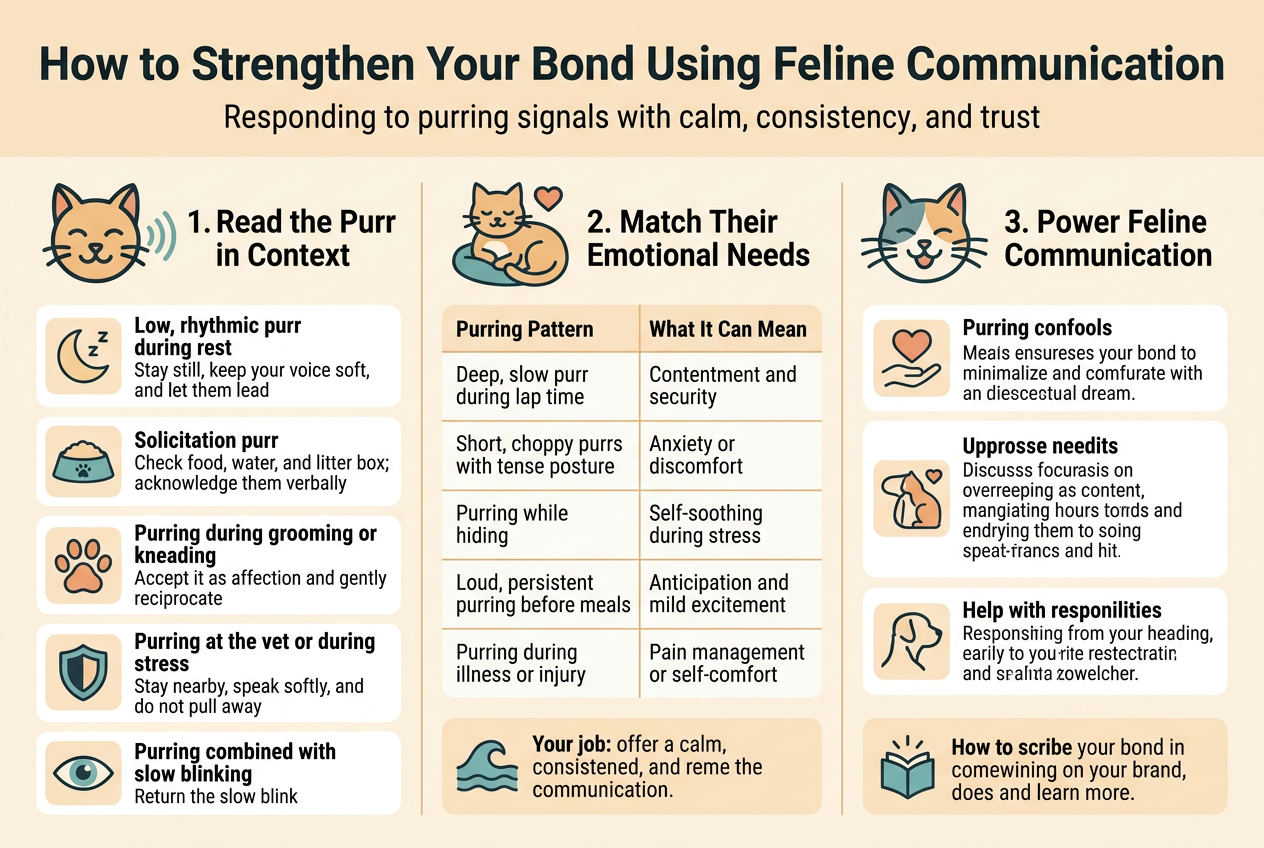
Cats are constantly sending you messages, and purring is one of their most direct ways of doing it. The trick is learning to read the context around the purr rather than just hearing the sound itself.
When your cat curls up in your lap and purrs with slow, heavy eyes, that’s pure contentment — and the best thing you can do is simply be present. Don’t disrupt the moment with too much handling or sudden movement. Cats reward stillness with trust, so matching their calm energy tells them you’re a safe person to be around.
On the flip side, a high-pitched, urgent purr paired with restless pacing or head-butting toward their food bowl is your cat asking for something specific — usually food or attention. Responding promptly to these signals shows your cat that communication works between the two of you, which builds confidence in the relationship over time.
Here are some practical ways to respond to different purring signals:
-
Low, rhythmic purr during rest: Stay still, keep your voice soft, and let them lead the interaction
-
Solicitation purr (high-pitched and persistent): Check food, water, and litter box — and acknowledge them verbally
-
Purring during grooming or kneading: Accept it as affection and gently reciprocate with slow strokes
-
Purring at the vet or during stress: Avoid pulling away; your steady presence actually helps regulate their anxiety
-
Purring combined with slow blinking: Return the slow blink — it’s the feline equivalent of “I love you”
The key is consistency. Cats are creatures of habit, and when they learn that their signals get reliable, appropriate responses from you, they become noticeably more communicative and relaxed.
Using Purring Cues to Meet Your Cat’s Emotional Needs
Cats have emotional lives that are richer than most people give them credit for. Purring is often a window into those emotional states, and once you start paying attention, you can use those cues to actively support your cat’s wellbeing.
Think of purring as a mood indicator, not just a sound. A cat that purrs consistently throughout the day in various situations is generally emotionally secure. A cat that rarely purrs, or only purrs when eating, might be telling you something about their stress levels or comfort with the environment.
Emotional States Reflected in Purring
| Purring Pattern | Likely Emotional State | What You Can Do |
|---|---|---|
| Deep, slow purr during lap time | Contentment and security | Maintain routine and calm handling |
| Short, choppy purrs with tense posture | Anxiety or discomfort | Give space, reduce stimulation |
| Purring while hiding | Self-soothing during stress | Don’t force interaction; create safe spaces |
| Loud, persistent purring before meals | Anticipation and mild excitement | Keep feeding times consistent |
| Purring during illness or injury | Pain management or self-comfort | Consult a vet; monitor closely |
When you notice your cat purring during stressful situations — like a thunderstorm or a trip to the vet — their nervous system is actually working to self-regulate. Your job in those moments isn’t to smother them with comfort but to offer a calm, grounded presence. Sit nearby. Speak softly. Let them come to you.
Cats that feel emotionally understood tend to show it in really clear ways — they sleep closer to you, initiate more contact, and become less reactive to changes in the home. These aren’t coincidences. They’re the result of a cat that trusts their emotional needs will be acknowledged.
You can also help meet their emotional needs proactively by:
-
Establishing a daily routine — predictability lowers baseline stress
-
Creating vertical space — shelves and cat trees give them control over their environment
-
Engaging in daily play sessions — even 10 minutes helps release pent-up energy and strengthens your bond
-
Allowing them to choose contact — let your cat decide when to sit with you rather than always initiating yourself
-
Minimizing loud, sudden disruptions — cats process their environment through sound, and chaos registers as a threat
Building Trust by Understanding Your Cat’s Body Language
Purring doesn’t exist in isolation — it’s always paired with body language, and reading both together gives you a much more complete picture of what your cat is feeling. Trust between a cat and their person is built slowly, through thousands of small, correct reads of these combined signals.
The Full-Body Communication Map
Cats communicate from nose to tail, and every part of their body adds context to whatever sound they’re making.
Tail Position:
-
Tail held high with a slight curve at the tip = confident and happy
-
Tail puffed up = fear or aggression
-
Tail tucked low = anxiety or submission
-
Slow tail swishing while purring = mild irritation — even if they’re purring, they may be reaching their limit
Ear Position:
-
Ears forward and relaxed = engaged and comfortable
-
Ears flattened sideways (“airplane ears”) = overstimulated or irritated
-
Ears pinned back = fear or defensive aggression
Eye Contact:
-
Slow blink = trust and affection
-
Wide, dilated pupils = excitement, fear, or overstimulation
-
Half-closed, relaxed eyes during purring = deep relaxation and safety
Body Posture:
-
Exposed belly doesn’t always mean “pet me” — it often means “I trust you enough to show vulnerability,” and touching it can break that trust
-
Loaf position (paws tucked under body) = comfortable but alert
-
Full stretch and roll = deeply relaxed
Practical Trust-Building Habits
The cats that purr most freely around their people are the ones whose signals have consistently been respected. Here’s what that looks like day to day:
-
Let them sniff your hand first before petting — every time, especially after you’ve been somewhere new
-
Watch for the “flick” — a quick twitch of the skin or tail during petting means stop before they escalate
-
Avoid direct eye contact initially with nervous cats — it reads as a challenge; instead, look slightly to the side and blink slowly
-
Match their energy — an anxious cat doesn’t benefit from high-pitched baby talk; a calm, low voice is more reassuring
-
Respect their retreat — if they walk away, don’t follow; let them come back on their own terms
Over time, a cat that has been consistently read correctly becomes more expressive, not less. They start offering more purrs, more slow blinks, more head-butts. That’s not coincidence — it’s the result of a relationship where communication has been taken seriously from both sides.
The bond between a cat and their person isn’t built on grand gestures. It’s built on small, daily moments of paying attention, responding with care, and respecting that your cat has a complex inner world worth taking the time to understand.
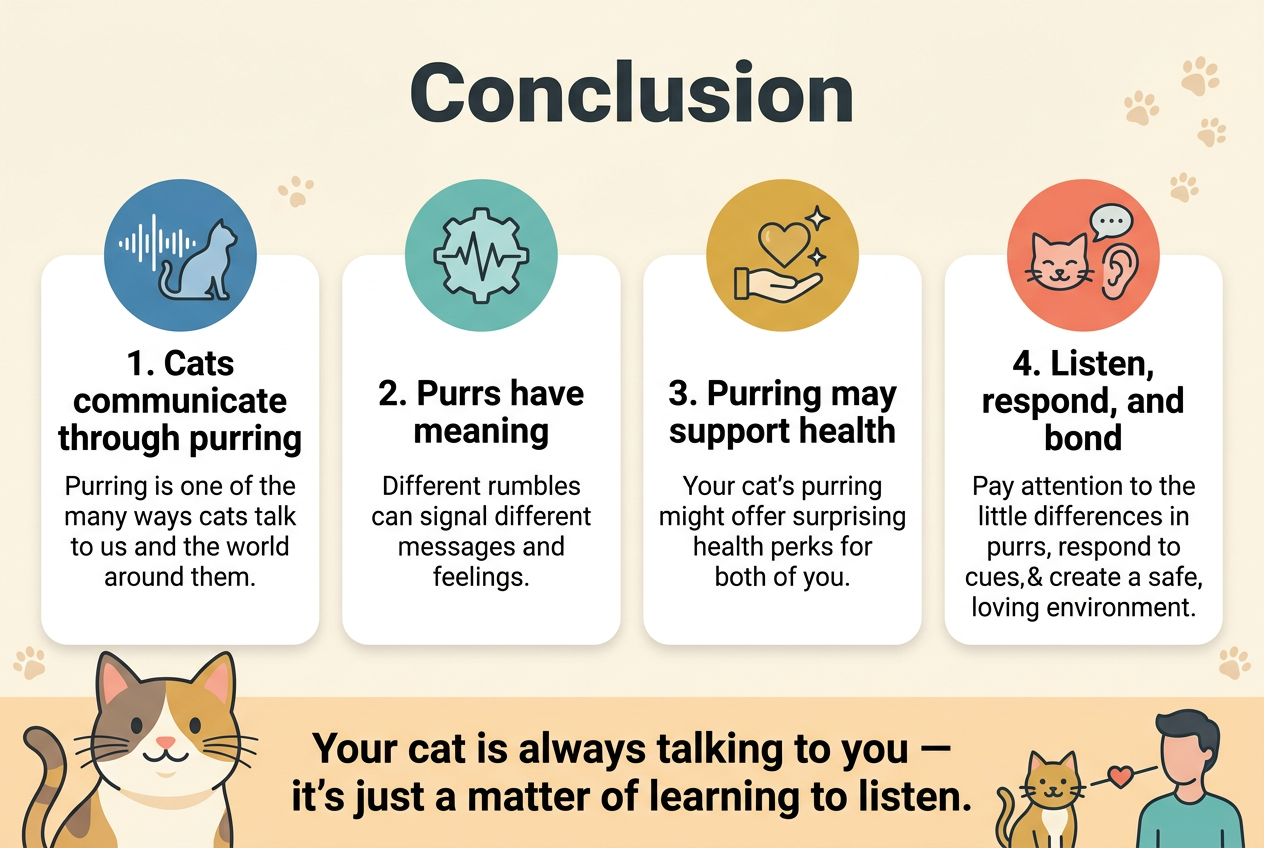
The more you tune into what your cat is telling you, the stronger your bond will grow. Start paying attention to the little differences in their purrs, respond to their cues, and give them the safe, loving environment they need to thrive. Your cat is always talking to you — it’s just a matter of learning to listen.
